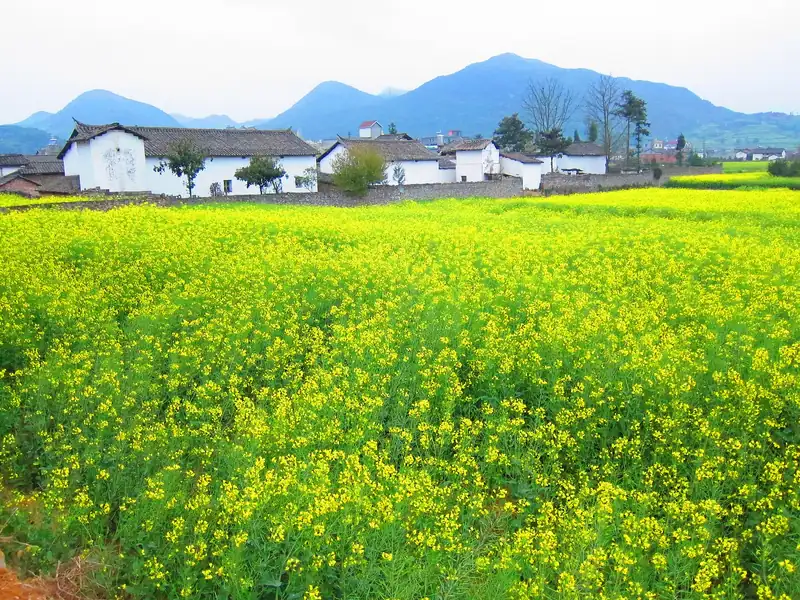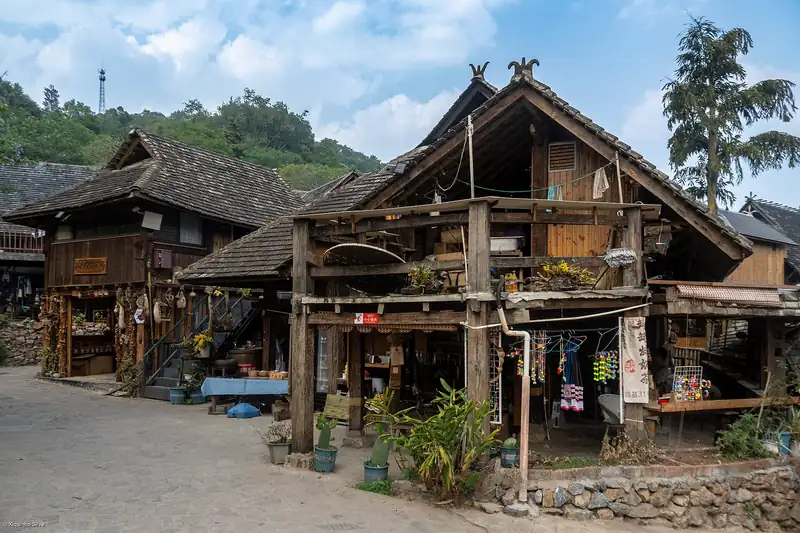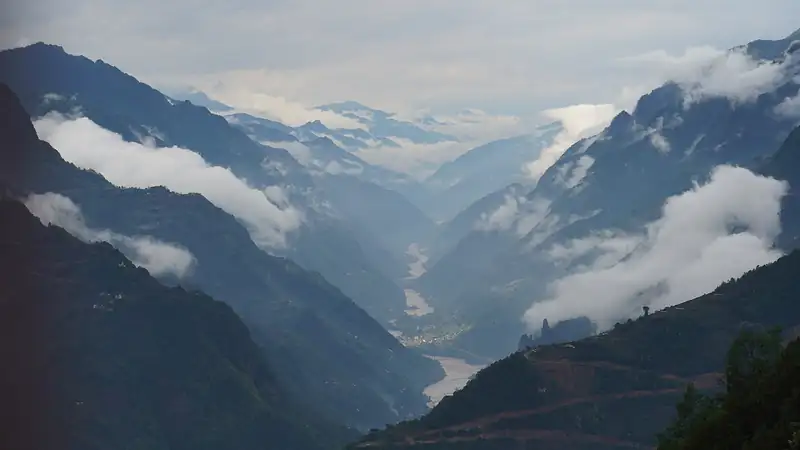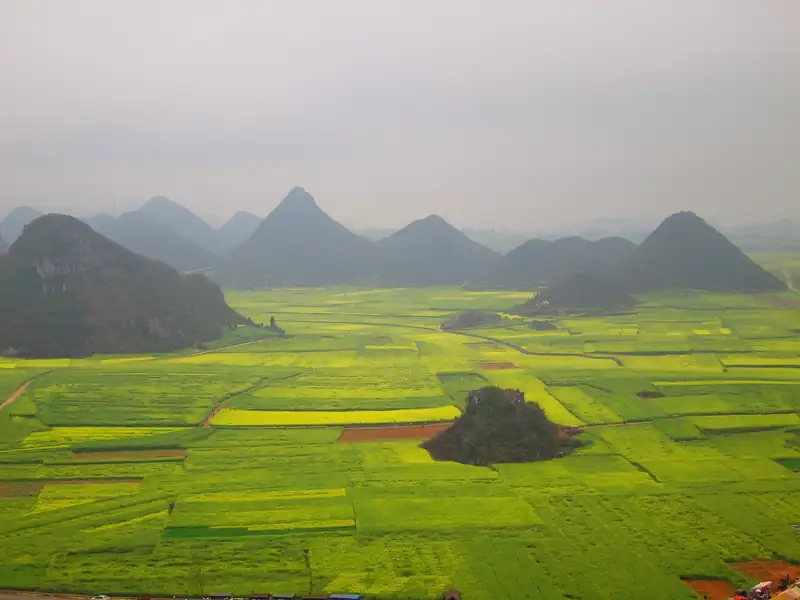
East of Kunming, Yunnan turns into karst country: steep limestone cones, rivers that vanish into caves and flat valley floors planted with rice and canola. For a few weeks each spring the canola flowers, and the fields around Luoping turn solid yellow between the peaks. It is one of China's best-known spring sights, and people plan whole trips around it.
This route pairs Luoping with three places most foreign visitors never hear of: Chengzi, a Yi and Han village of flat earthen roofs stacked up a hillside; Puzhehei, a chain of lakes threaded between karst hills; and Bamei, a Zhuang farming village you enter by boat through a river cave. You travel with a driver, because buses here are sparse and the best light comes at sunrise and sunset, though the book also covers a no-driver version, and you finish with a bullet train back to Kunming.
Who it's for
- Spring travelers in mid-February to March, when the canola is out. In summer the route still works, with green fields and lotus at Puzhehei instead.
- Photographers and early risers. The best light here comes at sunrise, so most days start early.
- Second-time visitors and anyone with five spare days around Kunming. Nothing on the route is much higher than Kunming, so altitude isn't a concern.
Not for you if you want old towns and nightlife: this is countryside, with simple farmstays and early nights.
The route at a glance
- Day 1: Drive from Kunming to Luoping; spiral terraces in the afternoon light
- Day 2: Sunrise over the karst peaks, waterfalls and quiet terraces
- Day 3: The flat-roofed village of Chengzi, then on to Puzhehei
- Day 4: Puzhehei at dawn and by boat, then into Bamei by boat before dark
- Day 5: Morning mist in Bamei, then the bullet train back to Kunming
You need a car and driver from Kunming until the last morning. Public transport reaches Luoping town and Puzhehei station, but not the viewpoints, terraces and villages, and not at sunrise. The trip ends with a bullet train back to Kunming.
Prices as of 2026; check before you go.
Before you go
- Driver: Book one car and driver for all five days, from your Kunming hotel to the station on Day 5. Agree in writing on the total price, the driver's meals and rooms, and pre-dawn starts on Days 2 and 4. We can arrange this at a fixed price.
- Watch the flower reports: The canola usually peaks from mid-February to mid-March, but it shifts by a week or two each year. Chinese sites post a "flower report" 花讯 through the season; ask your host or driver about a week before you go.
- Book rooms early: In canola season, farmstays near the peaks fill at weekends. The Spring Festival holiday, around 6 February 2027, is the busiest week of all.
- Pack for Bamei: You enter by small boat and walk to your guesthouse, so bring one overnight bag and leave the big case in the car.
- Bring: sunscreen and a hat (the spring sun is strong), shoes with grip for muddy field paths, a headlamp for dawn climbs, insect repellent and a rain layer. See payments for paying in villages.
Day by day
Day 1 Kunming to Luoping, and the spiral terraces
About three hours east by road, then an afternoon at the terraces that look like a fingerprint.
- Morning Leave Kunming by 9 a.m. Luoping 罗平 has a railway station about 1.5 km from town, but no bullet trains stop there: the three daily conventional trains from Kunming Station take three and a half to six hours, and the sights are spread across the county with no reliable buses.
- Lunch In Luoping town, then check in.
- Afternoon Drive to the Niujie spiral terraces 牛街螺丝田. Terraces wind around low hills in tight rings, yellow and green in season. They're free to see; there's a viewing platform, and parking costs about ¥10. The afternoon is best, with the sun behind you.
- Evening Back for dinner and an early night. Stalls by the fields sell canola honey by the jar; beekeepers bring their hives to the flowers each spring.
Overnight: Luoping, a farmstay near the Golden Rooster Peaks 金鸡峰丛 where you can see the fields from your window (the most popular choice), or a hotel in town for more comfort. 2 nights.
Day 2 Sunrise over the peaks, waterfalls and quiet terraces
The day this route is built around. Set an alarm.
- Dawn The Golden Rooster Peaks 金鸡峰丛 are the image everyone comes for: dozens of karst cones standing in the fields, often wrapped in morning mist so they look like islands in a yellow sea. Sunrise is around 7:10–7:30 a.m. from mid-February to mid-March, a little earlier by late March; be in place 30 minutes before. There are three paid viewpoints (about ¥30 each), and you need only one. Pick Laojianshan 老尖山, about 20 minutes' climb. Or ask your farmstay host which small hill nearby is free to climb; the view is nearly as good.
- Morning Walk or cycle through the fields as the mist lifts. Bikes and a little tourist train are for hire around the peaks, and sellers offer flower garlands for photos (about ¥10).
- Late morning The Jiulong waterfalls 九龙瀑布群 (about ¥65): a chain of falls over limestone ledges. Enter by the West Gate and walk downstream past the falls, then ride the shuttle back from the East Gate so you never walk the same path twice. In spring the water is lower but still pretty; in summer it thunders.
- Afternoon Quiet terraces, with fewer people and denser flowers. Gegang village terraces 革岗村梯田: type the junction of roads Y074 and Y045 into the map, the spot photographers share. Majie terraces 马街梯田 are about 40 km from town (navigate to Songmao village 松毛村). Pinde village 品德村 is free and usually empty. Pick one or two; the roads are narrow.
- Evening Sunset from a hillside near the peaks, around 7 p.m. in canola season, then dinner at your farmstay.
Overnight: Luoping
Day 3 Chengzi, the village of earthen roofs, then Puzhehei
A long road day with one stop that earns the detour. Chengzi is optional; skipping it gets you to Puzhehei by early afternoon.
- Morning Leave Luoping by 8 a.m. and drive southwest to Luxi county 泸西县. Chengzi 城子古村 lies in Yongning township, roughly 25 km from the county town. Allow about 3 hours from Luoping; the last stretch is slow village road.
- Late morning Chengzi has more than 600 years of history, and Yi and Han families live side by side. Its houses are tuzhangfang 土掌房: thick earthen walls with flat mud roofs, built so closely up the slope that one family's roof is the next family's front yard. Walk up through the lanes to the top of the village for the view over the roofs, about 1.5–2 hours in all. Autumn, when harvests are spread to dry on the flat roofs, is when it's at its best.
- Lunch A simple farmhouse meal in the village or back in Luxi town.
- Afternoon Drive on to Puzhehei 普者黑 in Qiubei county, roughly 2–2.5 hours on country roads. Its name comes from the Yi language and is usually translated as "a place rich in fish and shrimp": a string of shallow lakes and channels threaded between karst hills.
- Evening Dinner in the village. Order sour soup fish with wild tomatoes 野生番茄酸汤鱼, clear-broth fish 清汤鱼 or sour soup chicken 酸汤鸡. Wenshan grows most of China's sanqi 三七, a medicinal root, and steam-pot chicken cooked with it 三七汽锅鸡 is the local comfort food. In summer, restaurants serve dishes made with lotus.
Overnight: Puzhehei. Xianrendong village 仙人洞村, a Yi village with the most guesthouses and restaurants, is liveliest in the evening; Puzhehei village 普者黑村 is closest to the Qinglong Mountain viewpoint; Bailianshan village 白脸山村, near the main gate, is the best value.
Day 4 Puzhehei at dawn and by boat, then into Bamei
Morning on the lakes, lunch, then a 1.5-hour drive to reach Bamei before the last boat.
- Dawn Climb Qinglong Mountain 青龙山, about 20 minutes' climb from Puzhehei village, for sunrise over the lakes and peaks. It's the best view in the area, and it has usually been free (check locally). (The White Face Mountain viewpoint 白脸山, about ¥30, is the paid alternative.)
- Morning Take a boat through the lakes (about ¥80 including the electric shuttle; boats run 8 a.m.–5 p.m.). In summer you glide through lotus; in spring the water is clear and the peaks reflect in it.
- Early afternoon Drive about 1.5 hours to Bamei 坝美 in Guangnan county 广南县. Aim to arrive by 3:30 p.m.: boats into the village run from about 8:30 a.m. to 5 p.m.
- Late afternoon Buy your ticket (about ¥85) and take the boat through a long, dark river cave into the valley. The moment you come out of the dark into the fields recalls the old fable of the Peach Blossom Spring, a hidden valley where time stopped. Visitors still come and go by boat, and the Zhuang villagers farm the valley floor much as their grandparents did. Walk to the old banyan tree, and be at the bamboo-raft pools between 5 and 6 p.m., when rafts and farmers stand in silhouette against the light.
- Evening Eat at your guesthouse. Ask for the Zhuang "winnowing-basket feast" 簸箕宴: five-color sticky rice, smoked pork and wild greens spread on a round bamboo tray and eaten with your hands, with the house rice wine. Afterward, step outside: with no town nearby, the stars are sharp.
Overnight: Bamei, a family guesthouse inside the village (your driver sleeps outside the valley)
Day 5 Morning mist in Bamei, then back to Kunming
Bamei is at its best between 7 and 9 a.m.; leave after that.
- Dawn Mist often fills the valley at first light. Go back to the raft pools between 7 and 8 a.m. for the morning version of yesterday's silhouettes.
- Morning Walk the loop path around the valley floor, about 2 hours at an easy pace, past fields that are yellow with canola in March and gold with rice in October.
- Late morning Take the boat out. Confirm with your guesthouse the night before where the boat out lands, and tell your driver where to wait.
- Afternoon Drive to Guangnan County station 广南县站, roughly an hour by road (ask your driver the night before), for a bullet train to Kunming South 昆明南站. The ride takes about 1 hour 40 minutes to 2 hours, and at last check trains left roughly every half hour to an hour from mid-afternoon into the evening. If the times don't suit, drive about 1.5 hours back to Puzhehei station 普者黑站, which has more trains: about 1 hour 15 minutes to Kunming South, for about ¥75.
Overnight: Kunming. See our Kunming guide.
Driver cards
Show these to your driver, station staff or guesthouse hosts.
请送我去牛街螺丝田观景台。
To the Niujie spiral terraces viewpoint.
明天早上看日出,请送我去金鸡峰丛老尖山观景台。几点出发合适?
Tomorrow for sunrise, the Laojianshan viewpoint at the Golden Rooster Peaks. What time should we leave?
附近有没有可以免费爬上去看日出的小山?
Is there a small hill nearby we can climb for free to watch the sunrise?
请送我去九龙瀑布群西门,我们从东门坐观光车出来。
To the West Gate of the Jiulong waterfalls; we'll come out by shuttle at the East Gate.
请送我去革岗村梯田,导航Y074和Y045的交叉口。
To the Gegang village terraces: navigate to the junction of Y074 and Y045.
请送我去泸西县永宁乡城子古村,看两个小时,然后去普者黑。
To Chengzi village, Yongning township, Luxi county, for two hours, then on to Puzhehei.
请送我去普者黑仙人洞村。
To Xianrendong village, Puzhehei.
请问去仙人洞村的8路公交车在哪里坐?
Where do I catch the No. 8 bus to Xianrendong village?
明天早上想爬青龙山看日出,从哪里上山?
I want to climb Qinglong Mountain for sunrise tomorrow. Where does the path start?
请送我去广南县坝美景区,我们今晚住在村里,下午五点前要坐上进村的船。
To Bamei in Guangnan county. We're staying in the village tonight and need to catch a boat in before 5 p.m.
明天我们从哪个码头出村?司机在哪里等我们?
Which pier do we leave from tomorrow, and where should our driver wait?
请送我去广南县站(高铁站)。
To Guangnan County high-speed railway station.
包车前请先说好总价,包括油费、过路费和您的吃住。我们不去购物店。
Before we hire the car, please agree the total price, including fuel, tolls and your meals and room. No shopping stops.
Costs
- Luoping: Golden Rooster Peaks viewpoint about ¥30 (one is enough); Niujie terraces free, parking about ¥10; Jiulong waterfalls about ¥65; flower garland about ¥10.
- Puzhehei: lake boat about ¥80 including the shuttle; White Face Mountain viewpoint about ¥30; Qinglong Mountain usually free.
- Bamei: ticket about ¥85, including the boat in.
- Trains: Puzhehei to Kunming South about ¥75.
- Without your own driver: from Puzhehei station, bus No. 8 to the villages costs about ¥5 and a taxi about ¥60–80; a car from Puzhehei to Bamei costs about ¥200.
- Driver for 5 days: the main cost. Get a written quote that covers the driver's rooms and the return to Kunming.
Seasons
- Mid-February to mid-March: canola peak in Luoping; some years it runs from late February into early April. Bamei's canola follows in March. Luoping usually holds a canola festival in season, with dates announced locally.
- June to August: lotus season at Puzhehei, where summer days average a comfortable 25°C or so. Take boats early or late, not at midday. It's also the rainy season, with afternoon showers.
- October: rice harvest in Bamei, and crops drying on the roofs of Chengzi.
- Festivals: The Zhuang Third of the Third festival, on the third day of the third lunar month (usually late March or April; 9 April in 2027), brings singing and five-color sticky rice to villages around Guangnan. See festivals.
What to skip
- One Luoping viewpoint, not three: the peaks look much the same from each, so pay for Laojianshan or climb a free hill.
- The tram outside Puzhehei station: it only runs to the visitor center; take bus No. 8 or a taxi to the villages instead.
- The "Three Lives, Three Worlds" set 三生三世 at Puzhehei: a man-made scene built for fans of a TV drama filmed here, about ¥30; the real lakes are better.
- Swan Lake 天鹅湖 at Puzhehei: about ¥145 with the shuttle, a lot for one more lake view unless you have a spare afternoon.
- Puzhehei in canola season: the lotus ponds are bare in February and March; one night is enough, and the lakes and peaks are the draw.
Make it your own
- Summer version: give Puzhehei two nights for the lotus, keep Bamei, and see Luoping's green terraces and the Jiulong waterfalls at full flow.
- Three or four days, no Luoping: take the bullet train from Kunming South to Puzhehei, hire a local car to Bamei, and return by train.
- Add the southeast: Chengzi is in Honghe prefecture, like Jianshui and the Yuanyang rice terraces. Continue from Luxi on our free southeast terraces and old towns route.
- Add a slower morning in Luoping: the Duoyi River 多依河, lined with Bouyei villages and bamboo, is a gentler alternative to the waterfalls.