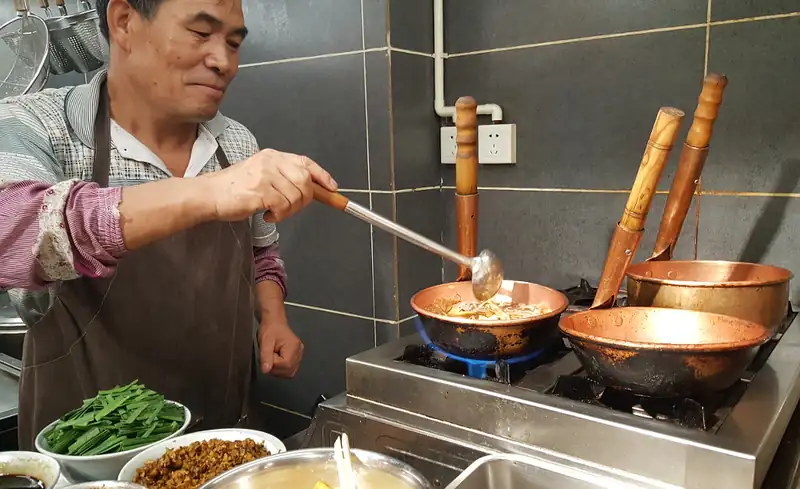
Short answer: Start the day with small-pot rice noodles, eat wild mushroom hotpot at a well-known restaurant if you're here in summer, and end the night at a barbecue stall. Most places take orders by QR code or pointing, and two words, bù là (not spicy), will get you a long way.
What to order
Kunming 昆明 is where food from all over Yunnan comes together, and eating is the best reason to spend an extra day here. These are the dishes worth hunting down.
Small-pot rice noodles 小锅米线
Kunming's everyday breakfast: one portion of rice noodles cooked to order in a small copper pot with minced pork, pickled greens and chives. It's quick, cheap and filling. Say how spicy you want it before the cook starts.
Crossing-the-bridge noodles 过桥米线
Yunnan's famous noodle set, originally from Mengzi in the south of the province. You get a large bowl of scalding broth and a spread of small plates, raw and cooked, that you add yourself (see how below). It's a proper sit-down meal rather than a quick bowl.
Wild mushroom hotpot 野生菌火锅
The big draw of the rainy season, roughly June to September, when Yunnan's markets fill with wild mushrooms. A platter of mixed varieties goes into a simmering broth at your table. Eat it only at established restaurants, and don't touch the pot until staff say it's ready; many set a timer.
Yunnan barbecue 烧烤
Kunming's late-night habit: skewers of meat, vegetables, tofu and potatoes grilled over charcoal and dipped in a dry chili-powder mix. Ask for the dip on the side if you're wary of heat.
Flower cakes 鲜花饼
Flaky pastries filled with sweetened edible rose petals. You'll see them everywhere, but they're best warm from a shop that bakes on site. They also make the easiest edible souvenir.
Grilled milk fan 烤乳扇
Thin sheets of dried cow's-milk cheese, a Bai specialty from the Dali area, grilled on a stick until chewy and spread with something sweet such as rose jam. People find it either delicious or far too sweet, so buy one to share.
Steam-pot chicken 汽锅鸡
Chicken cooked slowly in a clay pot with a chimney in the middle, so the broth forms from condensed steam. The result is clear, light and not spicy at all, which makes it a good break from chili.
Erkuai 饵块
Pounded rice cakes served several ways: toasted on a griddle and folded around sauce and fillings as a street breakfast, or sliced and stir-fried with vegetables and meat.
How to eat crossing-the-bridge noodles
The broth arrives close to boiling under a layer of oil that traps the heat, which is what cooks the raw ingredients. The order matters:
- Don't taste the broth yet. The oil hides how hot it is.
- Add the raw quail egg and the thinly sliced raw meat or fish first, and push them under so they cook.
- Next go the vegetables, tofu and anything else that only needs warming.
- Add the noodles last, season to taste, and eat.
If you look unsure, staff are used to showing people what to do.
How ordering works
QR codes at the table
Many restaurants have a QR code on the table instead of a paper menu. Scan it with WeChat or Alipay, choose your dishes and pay in the app. Menus are usually in Chinese only, but your phone's camera translation handles them well enough. You'll need mobile payment set up first; see payments and getting online.
Point at the pictures
Noodle shops and small canteens usually have a photo menu on the wall. Point, hold up fingers for how many, and you're done. Showing a photo of the dish on your phone works too.
Say how spicy
Yunnan food can be very hot, and "mild" here may still be spicy to you. Say it before they start cooking:
- 不辣 bù là: not spicy
- 微辣 wēi là: mildly spicy
- 不要香菜 bú yào xiāngcài: no cilantro
Vegetarian and allergy phrases
Strict vegetarian eating takes effort here. Noodle broths are usually made from pork or chicken bones, and a vegetable dish may come topped with minced meat. These phrases help:
- 我吃素 wǒ chī sù: I'm vegetarian
- 不要肉 bú yào ròu: no meat
- 这个是素的吗? zhège shì sù de ma?: Is this vegetarian?
- 我对花生过敏 wǒ duì huāshēng guòmǐn: I'm allergic to peanuts
- 我对海鲜过敏 wǒ duì hǎixiān guòmǐn: I'm allergic to seafood
Swap in 坚果 jiānguǒ (nuts), 鸡蛋 jīdàn (eggs) or 牛奶 niúnǎi (milk) as needed. Peanuts turn up often in Yunnan cooking, in toppings and dipping sauces.
Where to eat
Nanping Street 南屏街 and the Jinbi area
The city center around Nanping Street and the Jinma Biji archways 金马碧鸡坊 fills with food stalls and snack lanes in the evening. Small-pot noodles, grilled milk fan, flower cakes and barbecue are all within a short walk, so go hungry and share.
Green Lake 翠湖
Quieter streets around the lake and nearby Yunnan University, with small noodle shops, cafés and mid-range restaurants used by students and locals. A good base for breakfast noodles, and a walkable distance from the old center.
Mushroom hotpot restaurants
The best-known places are spread across the city, and in season the popular ones often have a wait of about an hour at dinner time. Arrive early, before the evening rush, or take a queue number and go for a walk.
For where to stay and what else to see, head to our Kunming guide. You'll meet grilled milk fan again in Dali, where it comes from.